
Vegetable Oils & Speciality Fats in Jordan – Understanding the Import Process
Importing vegetable oils and fats into Jordan involves understanding local regulations, certifications, compliance, and proper documentation. This guide will walk you through the necessary steps to import various vegetable oils, including RBD Palm Oil, RBD Palm Olein CP10, RBD Palm Oil CP8, RBD Super Palm Olein CP6, RBD Coconut Oil, and specialty fats like Cocoa Butter Substitute (CBS), Cocoa Butter Replacer (CBR), and others offered by Usha Edible Oil. We’ll also cover the benefits of long-term contracts with direct manufacturers and highlight how Usha Edible Oil stands out compared to its competitors.
Key Considerations for Importing Vegetable Oils & Specialty Fats into Jordan
Jordan is a significant player in the Middle East for the import and distribution of both edible oils and specialty fats. As an importer of vegetable oils like RBD Palm Oil, RBD Palm Olein CP10, RBD Palm Oil CP8, RBD Super Palm Olein CP6, RBD Coconut Oil, and specialty fats such as Cocoa Butter Substitute (CBS), Cocoa Butter Replacer (CBR), and Cocoa Butter Equivalent (CBE), it is crucial to understand the country’s regulations, certifications, and documentation processes.
The certification requirements are necessary to ensure food safety and product compliance for both categories of products. These regulations govern the importation of oils and fats to ensure they meet Jordanian health and safety standards.
This article will guide you through the regulations for importing vegetable oils and specialty fats into Jordan, covering the necessary documentation, customs duties, and best practices for storage and compliance. Additionally, we’ll explore the advantages of sourcing bulk supplies directly from manufacturers like Usha Edible Oil, and why establishing long-term contracts is beneficial for businesses seeking stable pricing and guaranteed product quality.
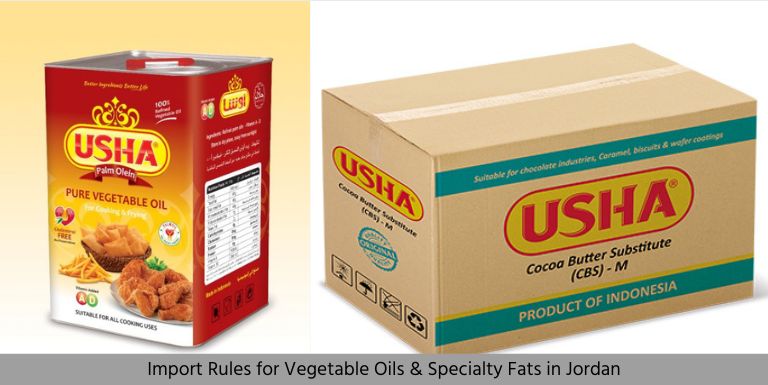
Jordan Edible Oil and Specialty Fats Import Requirements: JFDA, Halal Certification & Labeling Guide
The different certification regulates the safety and quality of food products entering Jordan, including edible oils and specialty fats. To successfully import these products, importers must meet certain requirements to ensure compliance with local laws and regulations.
Halal Certification
As a predominantly Muslim country, Jordan requires Halal certification for most food products, including vegetable oils such as RBD Palm Oil, RBD Palm Olein CP10, RBD Palm Oil CP8, RBD Super Palm Olein CP6, and RBD Coconut Oil, as well as specialty fats like Cocoa Butter Substitute (CBS) and Cocoa Butter Replacer (CBR). Halal certification ensures the products meet the standards of Islamic dietary laws, making them permissible for consumption by Muslim consumers.
- Halal certification is issued by accredited certifying bodies such as the Jordanian Islamic Center for Halal Certification.
- Labeling Requirements: All products, including vegetable oils and specialty fats, must have labels in both Arabic and English, detailing:
- The product’s name and origin.
- Halal certification to confirm compliance with dietary laws.
- Ingredients, including allergen information.
- Expiration date and storage instructions to ensure the product maintains its quality (especially for sensitive products like RBD Palm Olein CP10 and Cocoa Butter Replacer (CBR)).
- Health and safety information, including allergen warnings where applicable.

Palm Oil & Specialty Fats Importers in Jordan: Complete Buying & Compliance Checklist
When importing RBD Palm Oil, RBD Palm Olein CP10, RBD Palm Oil CP8, RBD Super Palm Olein CP6, RBD Coconut Oil, or specialty fats such as Cocoa Butter Substitute (CBS), Cocoa Butter Replacer (CBR), and Cocoa Butter Equivalent (CBE), compliance with the following guidelines is essential:
- Halal certification is mandatory for all edible oils and specialty fats.
- Obtain an import license from Jordan’s regulatory authorities to legally import food products.
- Product Documentation: Ensure you have all necessary shipping documents, including:
- Invoice: Detailing the product description and cost.
- Certificate of Origin: Verifying where the product is manufactured.
- Halal Certificate: Ensuring the product meets Halal standards for Muslim consumers.
- Customs Clearance Forms: Required to clear the goods through Jordanian customs.
Customs Duties and Taxes:
- Customs duties typically range from 5% to 10% of the product’s value, depending on the product classification.
- Value Added Tax (VAT): A standard 16% VAT is applicable to all edible oils and specialty fats, including RBD Palm Olein and Cocoa Butter Replacer (CBR).
Step-by-Step Guide to Importing RBD Palm Olein & Specialty Fats into Amman & Aqaba Ports
To import refined edible cooking oils or specialty fats, follow these steps:
Step 1: Find a Trusted Supplier
Ensure you are sourcing from a reputable RBD Palm Oil and specialty fats manufacturer like Usha Edible Oil, which guarantees that the oil and fats meet Jordan’s Halal and JFDA standards. Usha Edible Oil offers a reliable and consistent supply of high-quality oils and fats, ensuring compliance with all regulations.
Step 2: Prepare the Required Documents
- Certificate of Origin
- Invoice
- Halal Certification
- Shipping Details (Bill of Lading)
Step 3: Shipping Process
Ship the oil through Amman Port or Aqaba Port, the main ports for edible oil and fat imports into Jordan. Ensure your shipment complies with Jordan’s importation laws.
Step 4: Customs Declaration
Submit a customs declaration and specify the correct HS code for the oil. For RBD Palm Olein CP10, the appropriate HS code falls under 1507, while other oils and fats may have different classifications.
Step 5: Payment of Duties & Taxes
- Pay the customs duties (typically 5%-10% of the product value) and VAT (16%) as required by Jordan’s import laws.
Customs Duty, HS Codes & Tax Structure for Vegetable Oil & Specialty Fat Imports in Jordan
For vegetable oils, including RBD Palm Oil, RBD Coconut Oil, and specialty fats like Cocoa Butter Substitute (CBS), Cocoa Butter Replacer (CBR), and Cocoa Butter Equivalent (CBE), the HS code plays an essential role in the import process. Accurate HS classification is crucial for proper customs clearance and determining the applicable duties and taxes.
HS Codes for Vegetable Oils & Specialty Fats:
- RBD Palm Oil: HS Code 1511
- Refined Vegetable Oils: HS Code 1507
- Hydrogenated Oils: HS Code 1516
- Specialty Fats:
- Cocoa Butter Substitute (CBS): Typically under HS Code 1516.
- Cocoa Butter Replacer (CBR): Typically falls under HS Code 1516 or 1804 depending on composition.
- Cocoa Butter Equivalent (CBE): Usually falls under HS Code 1516 or 1804 as well.
Customs Duties:
- Import duties on vegetable oils and specialty fats range between 5% and 10%, depending on the product type and classification.
- VAT: A standard 16% VAT applies to all edible oils and specialty fats entering Jordan.
ALSO, READ THIS : Why Long-Term Supply Contracts Matter for Jordan Edible Oil & Fats Importers?
Shelf Life, Storage & Climate Considerations for Edible Oils & Specialty Fats in Jordan
Jordan’s climate characterized by hot, dry summers and fluctuating temperature conditions – makes proper storage a critical factor for maintaining the quality and safety of both vegetable oils and specialty fats. Improper storage can accelerate oxidation, rancidity, and degradation, leading to reduced shelf life, off‑flavors, and compromised functional performance. Importers must therefore pay close attention to how products like RBD Palm Oil, RBD Palm Olein CP10, RBD Coconut Oil, and specialty fats such as Cocoa Butter Substitute (CBS) and Cocoa Butter Replacer (CBR) are stored once they arrive in Jordan.
General Storage Principles for Vegetable Oils & Specialty Fats
All edible oils and fats whether bulk vegetable oils or value‑added specialty fats – share some common requirements for optimal storage:
Cool, Temperature‑Stable Environment
- Aim to store oils and fats at 15°C – 20°C.
- Avoid dramatic temperature fluctuations, which can cause condensation inside drums or containers, accelerating oxidation.
Darkness & UV Protection
- Sunlight and UV exposure cause photooxidation, a process that quickly deteriorates oil quality.
- Use opaque containers or shaded warehouses to protect light‑sensitive products.
Dry Conditions
- Moisture contact may promote hydrolytic rancidity and microbial contamination.
- Ensure storage areas are dry with low humidity.
Minimized Air Contact
- Always keep containers sealed when not in use.
- Exposure to oxygen increases the rate of oxidation and spoilage.
Shelf Life & Storage Recommendations for Vegetable Oils
Below are key considerations commonly imported for vegetable oils into Jordan:
RBD Palm Oil / RBD Palm Olein (CP10, CP8, CP6)
- Typical Shelf Life: 12 – 18 months, depending on storage conditions.
- Notes:
- These oils are relatively stable due to saturated fat content.
- Nevertheless, avoiding high heat and direct sun increases longevity and keeps free fatty acid (FFA) levels low.
- Rotation of stock (FIFO — First In, First Out) is essential to ensure older inventory is used first.
RBD Coconut Oil
- Typical Shelf Life:12 – 24 months, depending on refining and storage.
- Notes:
- Coconut oil is naturally more resistant to oxidation than many polyunsaturated oils but still benefits from cool, dry storage.
- Ensure lids and seals remain intact to prevent moisture ingress.
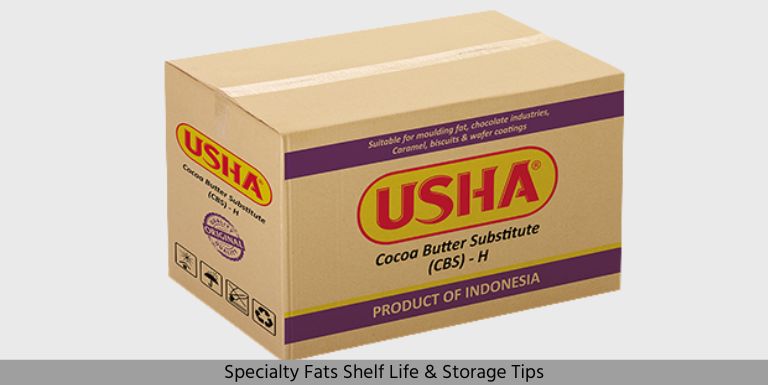
Shelf Life & Storage Guidelines for Specialty Fats
Specialty fats, including Cocoa Butter Substitute (CBS), Cocoa Butter Replacer (CBR) 100M, Cocoa Butter Equivalent (CBE), and Filling/Spreading Fats (CREAM SP19), are higher‑value products often used in confectionery, bakery, and chocolate applications. These fats require even more controlled environments than standard vegetable oils because their functional performance is closely tied to their melting behavior and composition.
Cocoa Butter Substitute (CBS) — (H & M Grades)
- Typical Shelf Life: 12 – 18 months
- Temperature Preferences: 15°C – 18°C
- Storage Conditions:
- CBS is sensitive to temperature instability; even slight heat spikes can alter its crystallization patterns.
- The ideal storage area should be well‑insulated with minimal temperature variation.
- Avoid storing near heat‑producing machinery.
Cocoa Butter Replacer (CBR) 100M
- Typical Shelf Life: 12 – 18 months
- Temperature Preferences: 15°C – 18°C
- Storage Notes:
- CBR 100M has functional properties similar to cocoa butter, making temperature control vital to preserve melting behavior critical in chocolate formulations.
- Humidity should be kept low, and pallets should be kept off the floor to avoid temperature stratification.
Cocoa Butter Equivalent (CBE)
- Typical Shelf Life: 12 – 24 months
- Temperature Preferences: 15°C – 20°C
- Storage Notes:
- CBE is slightly less temperature‑sensitive than CBS or CBR, but still benefits greatly from controlled conditions.
- Avoid long‑term storage at higher temperatures (above ~22°C), as this can lead to fat bloom issues in final products.
Filling/Spreading Fats (CREAM SP19)
- Typical Shelf Life: 9 – 12 months
- Temperature Preferences: 15°C – 20°C
- Storage Notes:
- Filling fats used in creams and fillings can be more susceptible to oil separation and textural changes if exposed to high heat.
- Ensure consistent storage temperatures at all times.
Climate Considerations in Jordan
Jordan experiences significant temperature swings especially hot summers and lack of humidity control in traditional warehousing can accelerate quality loss in both vegetable oils and specialty fats.
Seasonal Temperature Extremes
- Indoor temperatures can exceed 30°C or more, especially in non‑insulated facilities.
- Extreme heat accelerates oxidation in oils and disrupts the stable crystal forms of specialty fats.
Humidity & Moisture
- While Jordan is generally dry, variation in humidity — especially in port zones — can still affect storage conditions.
- Moisture control measures (dehumidifiers, sealed storage) help maintain oil quality and prevent moisture‑related degradation.
- Best Practices for Importers & Distributors
Here are practical steps to protect your inventory of vegetable oils and specialty fats: - Invest in Climate‑Controlled Warehouses
Climate control (even basic temperature regulation) protects against heat damage, oxidation, and fat crystallization issues. - Use FIFO (First In, First Out) Inventory Rotation
This ensures older stock moves first, limiting the risk of product degradation due to prolonged storage. - Check Seals & Packaging Integrity
Damaged seals can lead to moisture ingress or contamination; always inspect containers upon arrival. - Monitor Temperature & Humidity
Simple logging devices can provide data trends and help improve storage environments over time. - Segregate Oils from Specialty Fats
Specialty fats are more temperature‑sensitive and should ideally be stored separately from bulk vegetable oils to ensure optimal control.
By properly addressing shelf life, storage conditions, and climate risks, importers can significantly extend the usability of both vegetable oils and specialty fats ensuring both quality and regulatory compliance in the Jordanian market.

Why Jordan Importers Prefer Direct Manufacturers for Bulk Vegetable Oil & Specialty Fat Supply?
Importing vegetable oils like RBD Palm Oil and specialty fats such as Cocoa Butter Substitute (CBS) directly from manufacturers, like Usha Edible Oil, offers several benefits:
- Cost Efficiency: Sourcing directly from vegetable oil manufacturers like Usha Edible Oil eliminates intermediaries, resulting in lower prices for products like RBD Palm Olein and Cocoa Butter Replacer (CBR).
- Quality Assurance: Direct suppliers like Usha Edible Oil ensure strict quality control for all oils, such as RBD Coconut Oil and CBE.
- Long-Term Contracts: Establishing long-term contracts guarantees consistent supply and price stability, a major benefit for importers and distributors in Jordan
Final Thoughts on Importing Vegetable Oils & Specialty Fats into Jordan: Key Takeaways and Best Practices
Importing vegetable oils and specialty fats into Jordan requires adherence to local regulations, including Halal certification and proper documentation. By understanding the import duties, HS codes, and climate-related storage requirements, businesses can ensure a smooth importation process. Sourcing bulk vegetable oil supplies directly from manufacturers like Usha Edible Oil offers advantages such as cost savings, consistent quality, and long-term contract stability. This makes Usha Edible Oil an ideal choice for importers looking for high-quality edible cooking oils and specialty fats.
FAQs
What certifications are required for importing vegetable oils and specialty fats into Jordan?
- Halal certification is mandatory for both vegetable oils (like RBD Palm Olein and RBD Coconut Oil) and specialty fats (such as Cocoa Butter Substitute (CBS) and Cocoa Butter Equivalent (CBE)).
What is the VAT rate for vegetable oils and specialty fats in Jordan?
- The 16% VAT applies to all edible oils and specialty fats, including RBD Palm Oil, Cocoa Butter Replacer (CBR), and other related products.
How long does it take to import vegetable oils and specialty fats to Jordan?
- The import process generally takes between 7 to 30 days, depending on customs clearance, shipping method, and port of entry (Amman or Aqaba).
Why is it beneficial to import vegetable oils and specialty fats directly from manufacturers?
- Direct procurement from manufacturers, such as Usha Edible Oil, ensures lower costs, higher quality control, and more reliable supply chains. Long-term contracts also provide price stability and a consistent product supply.
What are the best storage conditions for vegetable oils and specialty fats in Jordan?
- RBD Palm Olein, RBD Coconut Oil, and specialty fats like Cocoa Butter Substitute (CBS) should be stored in cool, dark, and dry places. A temperature range of 15°C to 20°C is ideal for maintaining quality.
Author Bio

Sales Manager
Muhammad Usman, Sales Manager at Usha Edible Oil, combines years of industry experience with a strong focus on customer relationships. His expertise ensures that Usha Edible Oil delivers high-quality products, including RBD Palm Oil (CP6, CP8 and CP10), RBD Coconut Oil, Specialty Fats, Vegetable Shortening, Vegetable Ghee, and Margarine, to meet the diverse needs of global markets.
With a commitment to excellence, Muhammad continues to lead Usha Edible Oil in providing innovative and reliable vegetable oils, specialty fats, vegetable shortening, vegetable ghee, margarine export to various countries worldwide including Saudi Arabia, United Arab Emirates (UAE), Egypt, Syria, Qatar, Kuwait, Oman, Bahrain, Yemen, Iraq, Iran, Jordan, Lebanon, Palestine, Turkey, Sudan, solidifying its position as a trusted manufacturer, exporter, and wholesale supplier in the food industry.